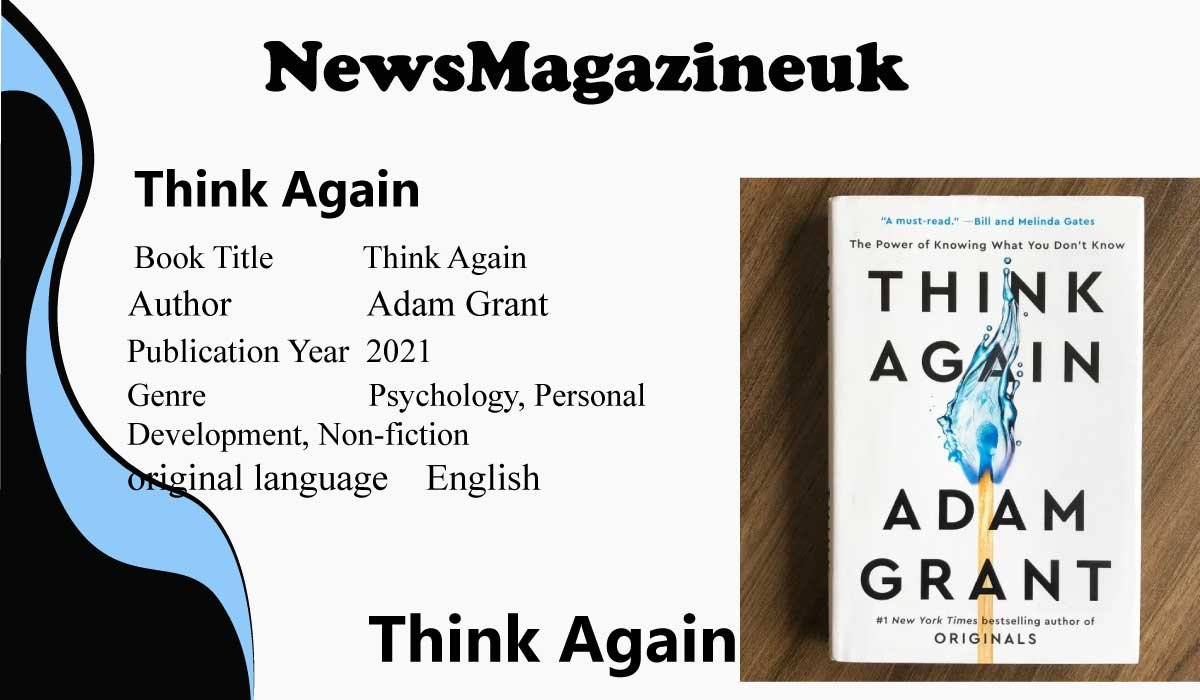
Think Again by organisational psychologist Adam Grant explores why people often struggle to reconsider their opinions and how developing intellectual flexibility can improve learning, relationships and decision-making. First published in 2021, the book encourages readers to question their assumptions rather than automatically defending familiar beliefs. Grant draws on research and real-world illustrations to examine how individuals and groups respond when their ideas are challenged. The book is particularly relevant to students, professionals, managers and anyone interested in psychology, communication or personal development. Its central concern is learning to remain open to better evidence.
Adam Grant Think Again Books Review
| Detail | Information |
|---|---|
| Book Title | Think Again: The Power of Knowing What You Don’t Know |
| Author | Adam Grant |
| Co-writer | None credited |
| Original Publication Year | 2021 |
| Original US Publisher | Viking |
| UK Edition Publisher | Verify the specific UK edition |
| Genre | Psychology, Personal Development, Non-fiction |
| Approximate Page Count | Around 320 pages, depending on edition |
| Available Formats | Hardback, paperback, ebook and audiobook; UK availability may vary |
| Main Subject | Rethinking beliefs and assumptions |
| Central Focus | Learning to reconsider opinions when new information becomes available |
| Main Purpose | To encourage more flexible thinking and better decision-making |
| Intended Audience | Students, professionals, managers and general non-fiction readers |
| Target Readers | People interested in psychology, communication and learning |
| Writing Approach | Research-led explanations combined with accessible stories and examples |
| Reading Style | Informative, conversational and reflective |
| Core Message | Being willing to rethink an opinion can be more valuable than defending it automatically |
| Key Theme 1 | Intellectual humility |
| Key Theme 2 | Curiosity and questioning |
| Key Theme 3 | Critical thinking |
| Key Theme 4 | Open-mindedness |
| Key Theme 5 | Learning from disagreement |
| Key Theme 6 | Evidence-based decision-making |
| Key Theme 7 | Personal growth |
| Key Theme 8 | Communication |
| Key Theme 9 | Adapting to new information |
| Key Theme 10 | Collaboration and group learning |
| Intellectual Humility | Recognising that personal knowledge has limits and that mistakes are possible |
| Rethinking Assumptions | Reviewing established beliefs rather than treating them as unquestionable facts |
| Curiosity | Seeking to understand why others hold different views |
| Productive Disagreement | Using differences of opinion to examine ideas instead of escalating conflict |
| Evidence and Beliefs | Considering relevant information before reaching or maintaining a conclusion |
| Changing Opinions | Understanding that revising a belief can reflect learning rather than weakness |
| Listening Skills | Giving other viewpoints proper consideration before responding |
| Communication Skills | Asking questions that encourage explanation and reflection |
| Workplace Relevance | Applying flexible thinking to decisions, feedback and teamwork |
| Educational Relevance | Encouraging students to question assumptions and remain open to learning |
| Leadership Relevance | Supporting environments where people can discuss mistakes and challenge ideas |
| Personal Development | Developing a habit of examining one’s own thinking |
| Decision-Making | Reviewing information and assumptions before settling on a choice |
| Group Learning | Helping teams discuss what worked, what failed and what should change |
| Main Thinking Challenge | People can become attached to their opinions and resist information that challenges them |
| Preacher Mindset | Defending beliefs that a person considers important |
| Prosecutor Mindset | Focusing on the weaknesses in another person’s argument |
| Politician Mindset | Seeking approval and support for one’s position |
| Scientist Mindset | Testing ideas and remaining open to evidence that may change a conclusion |
| Important Distinction | The book encourages reconsideration, not changing opinions without good reason |
| Practical Application | Reviewing a decision when reliable new evidence appears |
| Everyday Application | Listening carefully during disagreements and asking questions before judging |
| Professional Application | Seeking feedback and revisiting assumptions about a project or policy |
| Learning Application | Treating mistakes as opportunities to improve understanding |
| Main Strength | Makes the value of reconsidering beliefs understandable and relevant to daily life |
| Another Strength | Connects psychological research with familiar personal and professional situations |
| Potential Limitation | Some readers may find the reflective themes repetitive |
| Another Limitation | Readers seeking detailed step-by-step exercises may want more direct practical guidance |
| Difficulty Level | Accessible to general readers without specialist psychology knowledge |
| Best Reading Approach | Read thoughtfully and consider how the ideas apply to real decisions |
| Suitable for Book Clubs | Yes, particularly for discussions about beliefs, disagreement and decision-making |
| Suitable for Students | Yes, especially those interested in learning and critical thinking |
| Suitable for Managers | Yes, for reflection on feedback, teamwork and leadership |
| Suitable for Psychology Readers | Yes, as accessible popular psychology |
| Not Primarily | A novel, memoir or fast-paced narrative |
| Overall Reading Experience | An informative exploration of how people think, learn and respond to opposing views |
| Main Takeaway | Good judgement includes knowing when to reconsider what you believe |
| Related Adam Grant Book | Give and Take (2013) |
| Related Adam Grant Book | Originals (2016) |
| Related Adam Grant Book | Option B (2017), co-authored with Sheryl Sandberg |
| Related Adam Grant Book | Hidden Potential (2023) |
| Similar Book | Thinking, Fast and Slow by Daniel Kahneman |
| Similar Book | Mindset by Carol S. Dweck |
| Similar Book | The Scout Mindset by Julia Galef |
| Similar Book | Noise by Daniel Kahneman, Olivier Sibony and Cass R. Sunstein |
| Overall Verdict | A useful non-fiction read for people who want to question assumptions, improve communication and make more thoughtful decisions Read More Books |
Think Again Read Books
Think Again by Morvarid Borhanian
Key Ideas in the Book
The book examines how people can become more willing to reconsider their beliefs and learn from disagreement. Its ideas centre on intellectual humility, curiosity and the difference between defending an opinion and testing whether it remains valid. Grant also explores how conversations can become more productive when people ask questions, listen carefully and make room for uncertainty. He discusses the roles people adopt when arguing, including the tendency to defend beliefs like a preacher, attack opposing views like a prosecutor or seek approval like a politician. The book encourages a more evidence-focused approach.
| Idea | What it means in the book | Imagined situation |
|---|---|---|
| Intellectual humility | Recognising that personal knowledge is incomplete and that existing beliefs may need revision. | Imagined situation: A student admits they misunderstood a topic and asks their teacher to explain it again. |
| Rethinking assumptions | Treating opinions as ideas that can be tested rather than permanent truths. | Imagined situation: A manager reviews a long-standing workplace rule after noticing it no longer solves the problem. |
| Learning from disagreement | Using respectful challenges to examine reasoning instead of treating every disagreement as a personal attack. | Imagined situation: Two colleagues compare evidence before deciding which proposal is more effective. |
| Asking better questions | Showing curiosity through questions that help people explain their reasoning and consider other perspectives. | Imagined situation: During a family discussion, someone asks why a relative holds a particular view before responding. |
| Separating identity from beliefs | Avoiding the assumption that changing an opinion means losing one’s identity or values. | Imagined situation: A reader changes their position after studying new evidence without feeling that their character has changed. |
| Building a learning culture | Encouraging groups to welcome feedback, admit mistakes and improve ideas together. | Imagined situation: A team reviews an unsuccessful project openly and identifies changes for its next attempt. |
Review Strengths and Limitations
I find Think Again valuable because it makes reconsidering beliefs feel like a practical skill rather than a sign of weakness. Grant combines psychological research with accessible stories, helping readers connect abstract ideas to everyday conversations, work and decision-making. The discussion of how people defend their opinions is particularly useful for anyone who regularly handles disagreement. However, the book’s emphasis on reflection and changing one’s thinking may feel repetitive to readers already familiar with personal development literature. Some readers may also prefer more step-by-step exercises. Overall, it suits curious readers seeking better judgement and communication.
Who Should Read This Book
| Reader type | Good fit? (Yes / Maybe / No) | Reason |
|---|---|---|
| Students and lifelong learners | Yes | Encourages curiosity, reflection and openness to new information. |
| Managers and team leaders | Yes | Offers ideas for handling disagreement, feedback and group learning. |
| Readers interested in psychology | Yes | Explores thinking habits, beliefs and how people respond to challenges. |
| Readers wanting a fast-paced story | Maybe | It is an evidence-based non-fiction book, not a novel or thriller. |
FAQs
1. What is Think Again by Adam Grant about?
It explores why people hold on to their opinions and how they can become more open to changing their minds. The book focuses on learning, questioning assumptions and communicating across differences.
2. When was Think Again published?
The original US edition was published on 2 February 2021. UK editions have different publication dates depending on the format.
3. What is the main lesson of Think Again?
One central lesson is that being willing to reconsider an opinion can be more useful than defending it automatically. Grant encourages readers to approach beliefs with curiosity and examine new evidence.
4. Think Again suitable for beginners?
Yes. Grant explains psychological ideas in accessible language and uses stories to illustrate them. Readers do not need specialist knowledge of psychology to follow the main arguments.
5. Think Again worth reading?
It may be worthwhile for readers interested in critical thinking, communication and personal development. Those who prefer practical exercises on every page may find its research-led discussions less hands-on than expected.
Other Books by Adam Grant
- Give and Take (2013): Examines how giving, taking and exchanging help can influence professional relationships and success.
- Originals (2016): Explores how people develop, promote and act on ideas that challenge established ways of thinking.
- Option B (2017): with Sheryl Sandberg: Discusses resilience, adversity and finding ways to move forward after difficult experiences.
- Hidden Potential (2023): Examines how people can develop abilities and achieve growth beyond what their current performance might suggest.
Related Books You May Like
- Thinking, Fast and Slow by Daniel Kahneman: Explores how people think, make judgements and reach decisions.
- Mindset by Carol S. Dweck: Examines beliefs about ability, learning and personal development.
- The Scout Mindset by Julia Galef: Focuses on seeing situations clearly and assessing beliefs with greater objectivity.
- Noise by Daniel Kahneman, Olivier Sibony and Cass R. Sunstein: Investigates inconsistency in human judgement and ways to improve decisions.